The Concept Map
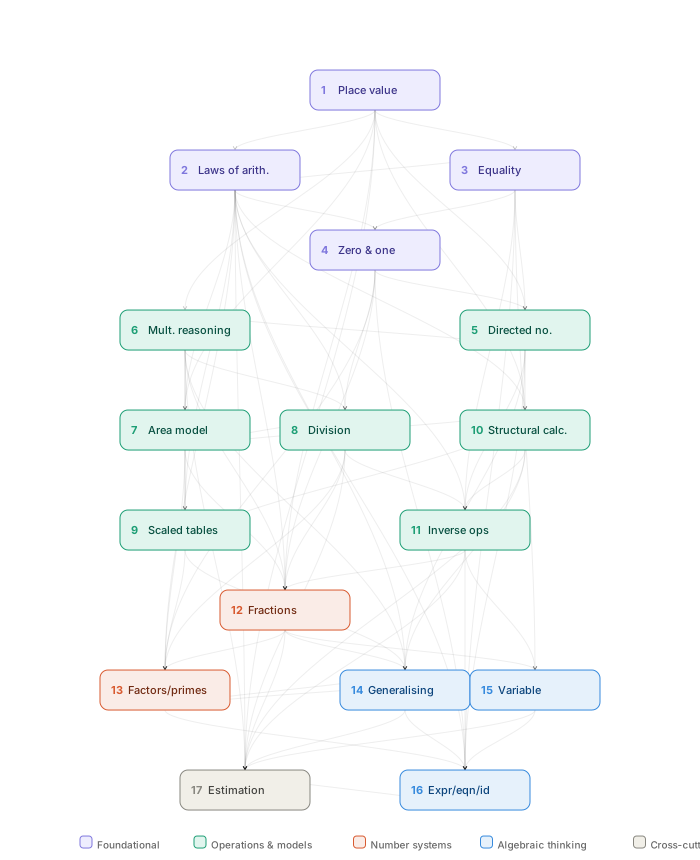
The framework covers 17 concept areas, sequenced by conceptual dependency. The concept map below shows how these areas connect to each other and where they lead into KS3 and KS4 topics.
How to read the map
Each concept area is shown as a node. Arrows indicate dependency: an arrow from Concept A to Concept B means that A must be in place before B can be taught meaningfully. The map also shows forward links to later curriculum topics (ratio, linear graphs, solving equations, and so on), which appear at the right of the diagram.
The map is not a teaching sequence. They can be taught through different schemes of work, and some concepts that appear in sequence in the document will, in practice, be taught in parallel. What the map does provide is a logical structure: it shows which concepts are genuinely prerequisite to which others, and which are independent.
The four major dependency chains
Four major chains of dependency run through the framework. These are the primary structural threads; the full map is more richly interconnected, but these chains capture the main lines of development.
Chain 1 - The arithmetic-to-algebra spine: Place Value → Laws of Arithmetic → Area Model → Division → Fractions → Factors and Primes.
This is the framework’s main structural backbone. Place value provides the raw material; the laws explain how it can be reorganised; the area model gives it visual form; division and fractions extend the system; and factors reveal the internal structure of numbers. Every link in this chain has a direct algebraic counterpart.
Chain 2 - The equality-to-algebra spine: Equality and Equivalence → Variable as a Concept → Expressions, Equations, and Identities.
Understanding what '' means is prerequisite to understanding what a variable is, which is prerequisite to distinguishing expressions from equations from identities.
Chain 3 - The proportional reasoning pathway: Multiplicative Reasoning → Division → Fractions → and onward into ratio, proportion, linear graphs, and trigonometry.
The shift from additive to multiplicative thinking is the gateway to proportional reasoning, which feeds forward into the dominant strand of KS3/KS4 mathematics.
Chain 4 - The generalisation pathway: Laws of Arithmetic → Scaled Tables → Generalising from Patterns → Variable → Expressions, Equations, and Identities.
This traces how generalisation develops: from the first general statements (the laws), through familiar multiplicative patterns, to using letters for generalised numbers, to distinguishing the algebraic objects. This chain delivers most directly on the framework’s central thesis.
The 17 concept areas
The following table lists all 17 concept areas in the framework’s dependency order. Each area has a full section expanding on the concept and it’s connections.
| # | Concept Area | Core Focus |
|---|---|---|
| 1 | Place Value and Unitising | Foundational to all number work |
| 2 | Laws of Arithmetic | The structural grammar |
| 3 | Equality, Equivalence, and the Equals Sign | Relational understanding of '' |
| 4 | Zero and One as Identities | Additive and multiplicative identities |
| 5 | Directed Number | Positive, negative, position, and direction |
| 6 | Additive and Multiplicative Reasoning | The shift to proportional thinking |
| 7 | The Area Model | Visual distributive structure |
| 8 | Division | Three meanings of division |
| 9 | Scaled Multiplication Tables | Relational fluency with facts |
| 10 | Structural Approaches to Calculation | Decomposition, equivalence, strategic choice |
| 11 | Inverse Operations and Fact Families | Operations as reversible processes |
| 12 | Fractions, Decimals, and Percentages | Connected number representations |
| 13 | Factors, Multiples, Primes | Internal structure of numbers |
| 14 | Generalising from Patterns | From specific to general |
| 15 | Variable as a Concept | Unknown, generalised number, varying quantity |
| 16 | Expressions, Equations, and Identities | Distinguishing algebraic objects |
| 17 | Estimation, Approximation, and Sense-Checking | Reasonableness as a habit of mind |
Concept Dependency Map
- Introduction
- Overview
- Unifying principles
- Concept map
Concept Reference
- Place Value and Unitising
- Laws of Arithmetic
- Equality Equivalence and the Equals Sign
- Zero and One as Identities
- Directed Number
- Additive and Multiplicative Reasoning
- The Area Model
- Division
- Scaled Multiplication Tables
- Structural Approaches to Calculation
- Inverse Operations and Fact Families
- Fractions Decimals and Percentages
- Factors Multiples Primes
- Generalising from Patterns
- Variable as a Concept
- Expressions Equations and Identities
- Estimation Approximation and Sense-Checking